


If you’ve been hunting for flexible solar panels that actually handle real-world use on vans, boats, or curved roofs, you’ve probably noticed there’s a lot of marketing fluff out there. Some bendy panels look great in photos, but crack, delaminate, or underperform after a season in the sun.
The Renogy 100W Flexible Solar Panel aims to solve that “looks good, fails fast” problem by combining serious output with a lightweight, low-profile build. I’ve spent a lot of time around off-grid setups, and this panel is one of the more practical options if you want power without heavy glass and bulky mounting hardware.
Below, I’ll walk you through what this panel actually does well, where it falls short, and who it makes sense for. I’ll also point you to a few resources if you’re planning a full off-grid or camping setup, so you can see how this panel might fit into a bigger system.
- High Power Output – The flexible solar panel can provide an average of 500 Watt-hours of electricity per day (depending …
- Easy to Transport, Carry and Install – The 100 watt solar panel suits most curved surfaces as it is bendable within 240 …
- Industry-leading Tech – Renogy 100w solar panel is equipped with half-cut PERC cell technology that enhances solar light…
Renogy 100W Flexible Solar Panel Product Showcase
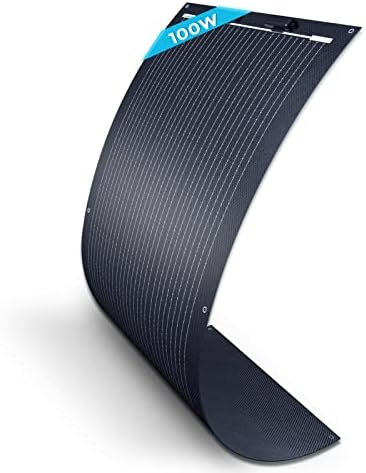
The Renogy 100W Flexible Solar Panel is designed for people who want reliable power without committing to rigid frames and roof racks. It’s a 12V, 100-watt monocrystalline panel built on a flexible substrate, which means it can bend up to 240 degrees and hug curved surfaces like van roofs, RV fronts, bimini tops, or even boat decks.
In normal sun, Renogy estimates you can get around 500 watt-hours per day from a single panel, assuming decent conditions. That’s enough to keep a 12V fridge going, charge phones, run lights, and top up a battery bank in a modest van or small cabin setup. For a lot of people, that’s the difference between rationing power and actually relaxing.
One of the first things you notice is the weight. At just 5.3 pounds, it’s roughly a third of what a comparable rigid 100 watt solar panel usually weighs. That makes a big difference if you’re working alone on a tall roof, or you simply don’t want to add unnecessary weight up high on a vehicle where every pound affects handling.
Aesthetically, it’s all-black and glare-free, which matters more than you’d think if you’re trying to keep your rig looking clean instead of like a science project. It sits low, doesn’t scream “solar,” and is much less likely to snag branches or catch wind on the highway.
If you’re just starting to explore solar panels for off grid living, having something this easy to mount and route cables from is a big confidence booster. You don’t need an elaborate rack system or a drill-filled weekend to get started.
Pros & Cons of the Renogy 100W Flexible Panel
Key Advantages
One of the biggest pros is the balance between flexibility and power. Many lightweight camping solar panels sacrifice efficiency, but here you’re getting a panel with half-cut PERC monocrystalline cells and a stated 22% efficiency. In practice, that means more usable energy from limited roof or deck space.
The 240° bend rating is another standout. You can mount it on curved fiberglass, metal, or composite surfaces where rigid modules simply won’t work. For vanlifers and boat owners, that means you can use awkward areas that would otherwise be wasted.
Durability-wise, it’s built to handle 5400 Pa of snow load and 2400 Pa of wind load, which is in the same ballpark as many framed panels. The IP67-rated junction box and connectors give you some peace of mind when it’s living permanently outdoors, exposed to spray, rain, or dust.
Installation is refreshingly simple. You get pre-drilled mounting holes plus about 2.3 feet of cable with standard solar connectors. You can through-bolt it, bond it down with adhesive, or even use strong hook-and-loop in some temporary setups, which makes it flexible not just physically, but also in how you deploy it.
Potential Drawbacks
There are trade-offs. Flexible solar panel designs generally have a shorter lifespan than high-quality, glass-covered rigid modules. While Renogy panels are known to be solid performers, if your priority is a system that will run for decades on a fixed cabin roof, rigid might still be the better long-term play.
Heat can also be a factor. Because these panels are often mounted directly against a surface, they can run hotter than elevated rigid panels, and hot panels are slightly less efficient. Proper mounting and a bit of airflow where possible will help, but it’s something to keep in mind.
Another thing: although this is marketed as lightweight and easy to mount, the wiring, controller, and battery side still require planning. If you’re new to DC systems, you’ll want to do a bit of homework or consult a reliable guide to make sure you size cables and protection correctly.
Finally, the panel’s output about 500 Wh per day in good sun may not be enough alone if you’re trying to run power-hungry gear like induction cooktops or full-time AC. In that case, you’d likely pair multiple panels in parallel or combine this with folding solar panels that you can deploy when parked.
- High Power Output – The flexible solar panel can provide an average of 500 Watt-hours of electricity per day (depending …
- Easy to Transport, Carry and Install – The 100 watt solar panel suits most curved surfaces as it is bendable within 240 …
- Industry-leading Tech – Renogy 100w solar panel is equipped with half-cut PERC cell technology that enhances solar light…
Description of the Renogy 100W Flexible Panel
Design, Build, and First Impressions
The Renogy 100W Flexible Solar Panel is built around monocrystalline half-cut PERC cells. That cell design helps capture more light, particularly when parts of the panel are shaded, and improves electrical performance under real-world conditions, not just lab-perfect ones.
The panel itself is thin and semi-rigid rather than floppy, which is actually a good thing. It has enough backbone that it won’t crease easily if handled properly, but it still conforms nicely when you gradually bend it into place across a curve. The surface has a nice matte, low-reflection finish that doesn’t draw unwanted attention.
The back side includes the junction box and cables, all sealed to IP67. That rating means it’s dust-tight and can withstand being submerged briefly, so constant exposure to rain and the occasional splash on a boat deck isn’t a problem. You still want to use good cable management and strain relief, of course.
Renogy pre-drills mounting holes around the perimeter, which helps if you’re fastening to a roof with screws and sealant. For adhesive mounting, the thin profile and relatively light weight make it easier to get a full, bubble-free bond compared with thicker options.
Performance and Power Output
On paper, the panel’s maximum power at standard test conditions is 100W, with an open-circuit voltage of 23.5V and a short-circuit current of 5.51A. In practice, under clear sun and a well-placed installation, seeing 70–90W in real-world conditions is common for quality 100W modules, and this one holds its own in that respect.
The estimated 500 watt-hours per day figure assumes several hours of strong sun and proper tilt. On a flat van roof, your output will be more seasonal and location-dependent, but for many users, it’s still enough to meaningfully support fridges, lights, fans, and regular device charging.
Because this is a 12V-nominal panel, it works well with common MPPT or PWM charge controllers designed for RV and marine applications. If you want more power, you can wire multiple panels in parallel using the built-in connectors and scale your array without changing your entire system layout.
Used as camping solar panels in a semi-permanent way say, bonded to a roof tent or portable panel board you get a nice balance of efficiency, weight, and simplicity. You’re not dragging around heavy framed glass, but you still enjoy meaningful energy production.
Real-World Use Cases
On vans and RVs, this panel really shines when mounted over curved front caps, fiberglass roofs, or in-between roof vents where rigid frames just won’t fit. It’s a favorite among people trying to squeeze every usable square inch from a small roof footprint.
For marine use, having flexible solar panel options means you can put power on bimini tops, dodgers, or cabin tops without creating tripping hazards or sharp corners. The low profile also helps reduce wind resistance and visual clutter.
Cabins, sheds, and tiny houses can also benefit. While you could use rigid modules there, some people simply prefer the cleaner look and lower wind profile of thin panels, especially when mounting to lightweight or older roofing materials.
And if you’re building a hybrid system, you can mix this with foldable solar panels that you deploy at camp. Keep this one permanently mounted to trickle in energy during drives or cloudy days, and use your portable array to “boost” your power on sunny, stationary days.
Specs
Electrical Specifications
- Maximum Power (Pmax): 100W at STC
- Maximum System Voltage: 600V DC
- Open-Circuit Voltage (Voc): 23.5V
- Short-Circuit Current (Isc): 5.51A
- Cell Type: Monocrystalline half-cut PERC
- Typical Daily Energy: ~500 Wh (depending on sun availability)
These values place it squarely in line with other quality 100 watt modules, with the added benefit of flexibility. As always, real-world performance depends on orientation, shading, temperature, and controller quality.
- High Power Output – The flexible solar panel can provide an average of 500 Watt-hours of electricity per day (depending …
- Easy to Transport, Carry and Install – The 100 watt solar panel suits most curved surfaces as it is bendable within 240 …
- Industry-leading Tech – Renogy 100w solar panel is equipped with half-cut PERC cell technology that enhances solar light…
Mechanical and Environmental Details
- Dimensions: 43.0 x 22.9 x 0.8 in (1093.0 x 582.0 x 20.5 mm)
- Weight: 2.4 kg / 5.3 lb
- Bend Radius: Up to 240° on suitable surfaces
- Operating Temperature: -40℃ to 80℃ (-40℉ to 176℉)
- Snow Load: Up to 5400 Pa
- Wind Load: Up to 2400 Pa
The wide operating temperature range and load ratings mean you can leave this panel out year-round in many climates. Whether you’re winter camping or summer cruising, it’s built to handle normal environmental stress without babying it.
Protection, Cabling, and Installation Readiness
- Junction Box: IP67 rated, waterproof and dustproof
- Connectors: IP67 rated solar connectors, pre-attached
- Cable Length: Approx. 2.3 ft (per lead)
- Mounting: Pre-drilled holes; compatible with adhesives and Velcro-type fasteners
- Reverse Current Protection: Integrated diode helps prevent battery discharge at night
This “ready to drop in” approach means most of your effort will be in planning your wiring runs, routing through the roof or deck, and integrating with your charge controller and batteries not wrestling with the panel itself.
Why We Recommend the Renogy 100W Flexible Panel
The main reason this panel earns a recommendation is that it hits a sweet spot of practicality. It’s not just a cool gadget; it actually solves a common off-grid problem: where to put solar when you don’t have a big, flat roof or want to keep your profile minimal.
If you’ve ever tried to mount rigid modules on a curved fiberglass RV cap, an older boat, or a sleek van roof, you know it can get awkward fast. This panel makes that easy. It lets you use surface areas that are normally wasted, turning them into real, usable energy production.
Another reason is consistency. Renogy is one of the more established players in the consumer solar space, and while no brand is perfect, they generally provide decent support, documentation, and ecosystem compatibility. That matters when you want your solar gear, wiring, and charge controller to all play nicely together.
From a usability standpoint, the low weight and easier handling are a big deal. Climbing a ladder with a glass panel in your hands is nerve-racking for a lot of DIYers. Being able to manage a light, flexible module reduces that barrier and makes it much more realistic to do a careful, clean installation without a whole crew.
Lastly, the panel fits well into both simple and advanced systems. You can start with one and a basic controller for a weekend camper, or scale out several of them plus a quality MPPT controller and a lithium battery bank for a full-time rig. You’re not locked into a toy-level product that you’ll outgrow immediately.
If you’re ready to check current pricing or add one to your system, you can find it here: Renogy 100W Flexible Solar Panel on Amazon.
Who This Is NOT For
This panel is not the ideal choice if your top priority is maximum lifespan on a fixed, open roof where weight and appearance don’t matter. In that scenario, a quality glass-and-aluminum 100 watt solar panel will usually outlast flexible designs and may cost a bit less per watt.
If you’re running truly power-hungry appliances a large air conditioner, electric cooktop, or heavy workshop tools you’ll likely outgrow a single 100W module almost immediately. You could still use this as a supplemental source, but it shouldn’t be your primary solution.
It’s also not for people who want a constantly repositioned, suitcase-style setup that they move every hour to chase the sun. While you can use it as a semi-portable panel, there are dedicated folding solar panels with integrated stands that are better suited for highly mobile use.
Finally, if you’re uncomfortable with any DIY electrical work and don’t want to learn even the basics, you might prefer an all-in-one solar generator kit where everything is plug-and-play. This panel is straightforward to install, but it still expects you to think through fuses, connections, and controller settings.
Complementing Ideas & Useful Resources
To get the most out of a panel like this, it helps to think in terms of a complete off-grid system: panel, controller, battery, and loads. If you’re mapping out solar panels for off grid living more broadly, you may want to combine roof-mounted flexible modules with portable gear you can aim at the sun when parked.
We’ve put together a practical guide to sizing and planning systems for cabins and small homes that pairs nicely with a panel like this: homeowner-friendly solar overview. It’s a helpful reality check before you start drilling holes or ordering large battery banks.
For van and RV setups, it can be useful to reference electrical safety and wiring best practices from trusted sources such as BoatUS technical resources, especially if your build will be exposed to vibration, salt, and constant movement.
If you’re exploring other gear that works well with lightweight modules, you might like our breakdown of compact folding solar panels for camping setups, which pair nicely with a permanent roof-mounted system like this one.
And if you’re in the research phase and just trying to understand how many panels you’ll likely need, our overview of what a 100W panel can realistically power is a good place to set expectations before you start buying hardware.
Used thoughtfully, a single 100W flexible module can be the backbone of a simple, reliable setup or the first building block in a much larger system as your needs grow.
- High Power Output – The flexible solar panel can provide an average of 500 Watt-hours of electricity per day (depending …
- Easy to Transport, Carry and Install – The 100 watt solar panel suits most curved surfaces as it is bendable within 240 …
- Industry-leading Tech – Renogy 100w solar panel is equipped with half-cut PERC cell technology that enhances solar light…
Your Questions, Answered
Can flexible solar panels like this Renogy 100W be walked on?
No, you should not walk on this panel or any similar flexible solar panels. While the laminate construction is designed to handle wind, snow loads, and motion on vehicles or boats, it is not meant to support body weight or concentrated pressure from shoes. Walking on the surface can crack cells internally, damage the protective layers, and dramatically reduce performance even if the damage isn’t visible at first glance. If you need panels on a walkway or deck area, plan your layout so you can step around them or install dedicated walking paths alongside the modules.
How many 100W panels do I need to run a 12V fridge in a van?
Most efficient 12V compressor fridges use somewhere around 30–60 amp-hours per day at 12V, depending on size, insulation, ambient temperature, and how often you open them. A single 100W panel that produces roughly 500 watt-hours per day can often support a small to medium fridge plus lights and device charging, as long as you also have an appropriately sized battery bank and a decent charge controller. For full-time use, cloudy climates, or larger fridges, many van owners choose to run two 100W panels so they have a buffer for bad weather and extra loads such as fans or laptops.
Do I need an MPPT charge controller with this 100W flexible panel?
You don’t strictly need an MPPT controller, but using one is usually a good idea if your budget allows it. A PWM controller will work and is fine for very simple systems, but an MPPT controller can often harvest more power throughout the day, especially when panel voltage and battery voltage differ significantly or when temperatures fluctuate. With a 100W module, the gains won’t be enormous, but if you plan to add more panels later or rely heavily on solar, MPPT is generally the better long-term investment.
How do I mount a flexible panel without drilling into my roof?
Many people use high-quality, UV-resistant adhesive to bond flexible panels to metal or fiberglass surfaces. You clean and lightly scuff the mounting area, apply adhesive according to the manufacturer’s instructions, and then press the panel into place, sometimes using temporary weights or tape while it cures. Some also use industrial-strength hook-and-loop systems so the panel can be removed later, though you need to ensure full contact and proper edge sealing to keep wind and moisture from getting underneath. Whatever method you choose, always think about drainage, cable routing, and heat buildup under the panel.
Are flexible solar panels suitable for permanent off-grid cabins?
They can be used on cabins, but they’re usually not the first choice for a long-term, fixed installation. For a permanent cabin where weight and roof curvature aren’t major issues, conventional glass-and-aluminum modules typically offer better long-term durability and value. Flexible modules make more sense when you have curved surfaces, strict weight limits, or a strong preference for low-profile aesthetics. Some people use a mix rigid panels as the main array on a roof or ground mount, and one or two flexible panels for auxiliary charging on sheds, awnings, or specialized surfaces.

We are a collective of off-grid enthusiasts, solar technicians, and sustainable living advocates dedicated to making energy independence accessible. From blackout-proofing suburban homes to engineering mobile power for the road, we rigorously test every kit and component we review. Our mission is to help you cut the cord and power your life on your own terms.