

If you’ve ever had the power go out right in the middle of cooking dinner, running your CPAP, or trying to keep the kids entertained, you already know how valuable a serious home backup system can be. And if you also like camping, RV travel, or working remotely from the road, a compact battery setup that can do all of that starts to feel less like a luxury and more like a necessity.
That’s exactly where the GRECELL H2400 Portable Power Station comes in. It’s a big step up from the typical little camping power bank with a couple of USB ports. We’re talking a true 2400W inverter, 1843Wh LiFePO4 battery, fast 2-hour recharge, UPS functionality, and enough ports to power a small off‑grid cabin for a weekend.
In this review, I’ll walk through what it’s like to actually live with this unit: what it handles easily, where its limits are, and who will genuinely benefit from investing in something this capable. I’ll avoid the usual spec-sheet jargon as much as possible and focus on how it behaves in real-world use at home, in an RV, and outdoors.
GRECELL H2400 Portable Power Station Product Showcase
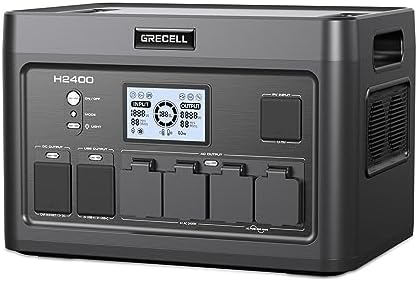
- Capable of Recharging 99% of Your Devices: Our power station has a huge capacity 1843.2Wh and a 2400W AC inverter (4800W…
- Fast Recharge: With ultra-fast charging from a Max 1200W household AC input allows full recharge GRECELL H2400 within 1….
- Power 11 Devices Simultaneously: You can charge your electronics and small appliances up to 11 simultaneously! 4×110V/24…
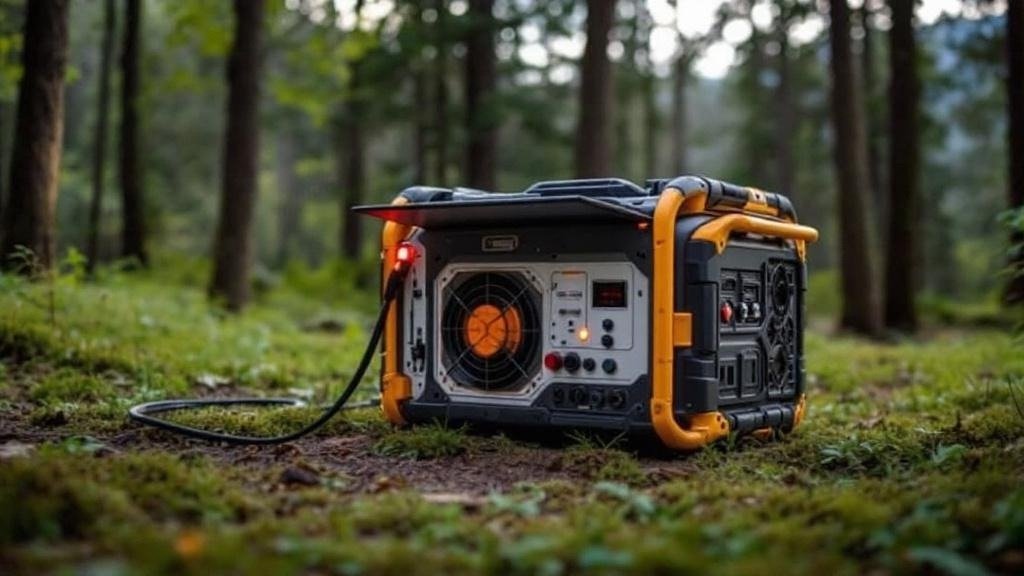
The GRECELL H2400 is essentially a compact home battery backup that you can still pick up and load into a trunk. Inside, you’ve got a 1843Wh LiFePO4 battery paired with a 2400W pure sine wave inverter (4800W surge). In plain language, that means it will run almost any standard household appliance under 2400W: full-size fridge, microwave, window AC, coffee maker, hair dryer, power tools, even some small electric heaters.
On the front panel, you get four 110V AC outlets, two USB-C PD 100W ports, two USB-A QC 3.0 ports, two 12V/5A DC outputs, a 12V/10A car socket, and a built-in 5W LED light. That’s enough to keep laptops, phones, routers, and portable fridges running at the same time, while still having room to plug in heavier gear when you need it.
What really sets it apart from a typical portable power station is the UPS mode. Plug the unit into the wall, then plug your sensitive devices into the AC ports, and it will automatically take over within about 10ms if the power drops. That’s fast enough to keep a desktop PC or router from rebooting and a fridge from cutting out mid-cycle.
Charging flexibility is another strong point. You can recharge from the wall at up to 1200W, which fills the battery from empty in roughly 1.6–2 hours. Add solar panels and you can dual-charge (AC + solar) to stay topped off during longer outages or off-grid stays. For road trips, you can still trickle charge from a car outlet, though that’s understandably slower.
If you want to check current pricing or specs directly, you can see the H2400 on Amazon here: GRECELL H2400 power station.
Pros & Cons
What This Power Station Does Really Well
The first major win is sheer output. At 2400W continuous with 4800W surge, this unit comfortably powers appliances that instantly knock cheaper options offline. In testing scenarios and user reports, it runs fridges, microwaves, coffee makers, induction cooktops (within limits), and power tools without drama. If you’re used to a smaller battery power station that trips as soon as you start something major, this feels like moving up to a real backup system.
The second strength is speed. Being able to recharge from the wall in about two hours changes how you use it. Instead of “saving” the battery for emergencies only, you can incorporate it into your normal routine charge during cheap off-peak hours, top it off between storms, or quickly juice it up before heading out for a weekend camping trip.
Third, LiFePO4 chemistry is a serious upgrade over older lithium-ion cells. You’re looking at 3500+ life cycles, which means years of frequent use before you notice meaningful capacity loss. It also runs cooler, is more stable, and is generally safer for indoor use which matters when you’re using it as a UPS in a bedroom or office.
Finally, the port selection is well thought out. The dual 100W USB-C outputs alone make it feel like a mini workstation hub. You can run power-hungry laptops at full speed, fast-charge smartphones, and still keep AC outlets free for heavier appliances. For households with mixed Apple/Windows devices, that’s a big quality-of-life upgrade.
Where It Falls Short (And Might Not Fit You)
There’s one tradeoff you notice immediately: weight. At around 55 lbs, this is not your typical little camping power bank you toss into a daypack. It’s portable in the sense that one reasonably strong adult can carry it, and the handles help, but you’re not hiking with it. Think “move between rooms, load into an RV, or carry from garage to campsite,” not backpacking.
The capacity while big is still finite. A 1843Wh battery will run a full-size fridge for many hours, but not for days on end without solar or grid recharge. If your goal is multi-day, whole-house backup, you’ll either want a larger system or to pair this with solar panels and careful power management.
UPS mode is fantastic, but it has a limit: connected devices need to be under 1800W. That’s perfectly fine for PCs, networking gear, small fridges, and medical equipment like CPAPs, but not for running multiple large heat-producing appliances at once off the UPS function.
Lastly, while the interface is clear and the LCD gives useful information (current, voltage, power, temperature, status), there’s no built-in wireless app control. If you like to monitor battery levels from your phone while you’re in another room, you’ll miss that feature. For many users, though, the front-panel readout is more than enough.
Description of the GRECELL H2400 Power Station
- Capable of Recharging 99% of Your Devices: Our power station has a huge capacity 1843.2Wh and a 2400W AC inverter (4800W…
- Fast Recharge: With ultra-fast charging from a Max 1200W household AC input allows full recharge GRECELL H2400 within 1….
- Power 11 Devices Simultaneously: You can charge your electronics and small appliances up to 11 simultaneously! 4×110V/24…
Real-World Capacity and Run Times
The headline number 1843Wh sounds impressive, but what does it actually mean in practice? In rough, real-world conditions, you can expect it to run a typical full-size refrigerator (around 120–150W average draw) for 10–12 hours or more, depending on door openings and ambient temperature. A CPAP machine can often run multiple nights, especially if you turn off the humidifier. Laptops sip power compared to appliances, so you could recharge a 60Wh laptop battery a dozen times or more.
For camping and RV users, a portable power station like this can run a 12V fridge, charge devices, power lights, and still have enough reserve to make coffee in the morning without anxiety. If you’re used to babying smaller batteries to make them last, the H2400 feels far more forgiving. You can plug in what you actually want to use, instead of constantly asking, “Will this trip the inverter?”
Keep in mind that high-wattage devices like microwaves or hair dryers will drain any battery quickly. That’s not unique to this unit it’s just how power math works. The advantage here is that the 2400W inverter lets you run those devices at all, whereas many compact units simply can’t.
Port Layout and Everyday Convenience
The front layout is clean: AC outlets grouped together, DC outputs off to one side, and USB ports up front where you naturally reach for them. The USB-C PD 100W ports are workhorses you can charge modern MacBooks and similar laptops at full speed while still topping up phones on the USB-A ports. For simple desk setups, it can be a one-box solution that powers everything quietly, with zero fumes.
The 12V ports and car socket are especially handy for overlanders and RV travelers. They pair nicely with 12V fridges, inflators, or low-voltage lights. While this unit is heavier than a glovebox power bank with AC outlet, it can replace multiple smaller devices and a gas generator in many scenarios, especially where noise or emissions are an issue.
The built-in 5W LED light won’t replace a dedicated lantern, but for power outages, basements, or the back of an RV, having an integrated light you can turn on instantly is more useful than it sounds. It’s one less thing to remember when the lights go out.
UPS Function and Indoor Safety
UPS mode is one of the features that makes this unit stand out. When set up between the wall and your devices, it quietly sits there, passing grid power through while keeping its battery topped up. If the power drops or spikes, it switches to battery in about 10ms. That’s quick enough that computers and routers don’t usually even flicker, and fridges keep running.
Compared to a traditional gas generator, using a LiFePO4 portable power station indoors is far safer: there are no fumes, no fuel storage, and no need to run extension cords through windows. It’s quiet, emits no exhaust, and can safely live in a bedroom, office, or living room. During storms or rolling blackouts, you just keep doing what you were doing, instead of scrambling to get a generator going outdoors in bad weather.
Battery Chemistry and Longevity
The choice of LiFePO4 cells is a big deal. These batteries are known for stability, long cycle life, and better performance over years of use. GRECELL rates the H2400 for 3500+ cycles before hitting around 80% of original capacity. If you cycle it a few times a week, that’s many years of reliable service. For people in areas with unstable grids, this long-term durability matters more than shaving a couple pounds off the weight.
The smart LCD shows you what’s happening under the hood: current draw, remaining capacity, input/output power, and temperature. This makes it much easier to learn how your devices actually use energy and to plan your backup strategy around that, instead of guessing. Once you’ve watched your fridge or CPAP over a few nights, you’ll know exactly how much margin you have.
Specs
Core Electrical Specifications
- Battery Capacity: 1843Wh / 576,000mAh (LiFePO4)
- Inverter Output: 2400W continuous, 4800W peak (pure sine wave)
- AC Outputs: 4 × 110V / 2400W (shared)
- USB-C Ports: 2 × PD 100W (5–20V/5A max)
- USB-A Ports: 2 × QC3.0 18W
- DC Outputs: 2 × 12V/5A ports, 1 × 12V/10A car socket
- Built-in Light: 5W LED
Charging, Solar, and Physical Details
- AC Recharging Input: Up to 1200W (approx. 1.6–2 hours from empty)
- Solar Recharging: MPPT controller, up to 1200W with compatible setup; around 3 hours with 800W input in good sun
- Dual Charging: AC + solar for faster top-ups
- UPS Mode: Switchover in approximately 10ms, for loads up to 1800W
- Battery Life Cycle: 3500+ cycles (to ~80% capacity)
- Weight: About 55 lbs
- Design: Rugged housing with integrated carry handles
For a quick manufacturer overview of LiFePO4 safety and design philosophy, GRECELL’s category pages are a useful reference. For broader context on LiFePO4 chemistry, you can also look at independent resources like Battery University, which goes deep into battery behavior and longevity.
Why We Recommend This Portable Power Station
- Capable of Recharging 99% of Your Devices: Our power station has a huge capacity 1843.2Wh and a 2400W AC inverter (4800W…
- Fast Recharge: With ultra-fast charging from a Max 1200W household AC input allows full recharge GRECELL H2400 within 1….
- Power 11 Devices Simultaneously: You can charge your electronics and small appliances up to 11 simultaneously! 4×110V/24…
The main reason this unit earns a recommendation is balance. It lands in a sweet spot where it’s powerful enough to handle serious household and RV loads, but still compact enough to move when you need to. You’re not dealing with a permanently installed system that needs professional wiring, yet you get a real sense of security when the grid starts acting up.
From a usability standpoint, it’s also far less intimidating than a gas generator. There’s no fuel stabilizer to think about, no carburetor to clean, and no noise restrictions at campgrounds. You plug it into the wall, keep it topped up, and when something goes wrong with the power, you just start using it. That “grab-and-go” simplicity lowers the barrier to actually preparing for outages.
Another reason we like it is flexibility. In daily life, it can function as a big, quiet power bank with AC outlet options for your entire workstation or entertainment setup. On weekends, it goes into the car, RV, or van and becomes your off-grid power hub. When storms hit, it steps into UPS mode and protects your most important gear. One purchase covers multiple roles that many people currently handle with several smaller gadgets.
Compared to a tiny power bank with AC outlet or a basic camping power bank, the H2400 moves you into a different league of capability. You’re no longer just keeping phones topped off; you’re keeping fridges cold, running tools, or quietly powering a nursing mother’s bottle warmer during a storm. That shift matters, especially for families, remote workers, and anyone with critical medical devices.
We also appreciate that GRECELL has an ecosystem around this unit matching solar panels and bundle options making it easier to build a complete setup over time. If you want to explore compatible gear, they maintain a lineup of generators and panels that pair well with this model: see bundles and accessories (check the variations and frequently bought together section).
Who This Is NOT For
As capable as it is, this isn’t the right choice for everyone. If your main need is an ultra-lightweight camping accessory for charging phones and maybe a tablet, this is overkill. You’d be better off with a compact camping power bank or a smaller portable power station that weighs under 15 lbs and costs a lot less.
Likewise, if you’re expecting it to fully replace a whole-house standby generator for multi-day outages without any solar support, you’ll be disappointed. It can absolutely carry the essentials through a night or even a full day, but running high-draw appliances nonstop will deplete the battery quickly, as any battery-based system would.
It also may not fit people with very limited mobility or those who can’t comfortably manage a 55 lb device. If you need to move it frequently up and down stairs, you may want to consider either a dolly/cart solution or a smaller-capacity option that trades power for portability.
Finally, if app-based monitoring and smart-home integration are must-haves for you, the lack of built-in Wi‑Fi or Bluetooth control could be a deal-breaker. In that case, you might prefer a smart station that integrates directly with an app, even if it costs more or offers slightly less raw output.
Complementing Ideas & Related Gear
To really get the most out of the H2400, pairing it with solar panels is almost a no-brainer. That’s what turns a powerful backup battery into a mini off-grid system. If you’re comparing panel sizes or wondering how much solar you actually need for weekend camping, our guide on portable solar setups can help: portable camping solar guide.
Another common pairing is a smaller everyday carry bank for phones and earbuds, plus a larger home unit like this for serious loads. If you’re exploring that two-tier setup, our overview of power banks with AC options and device-specific tips is a good next step: backup battery and power bank guide.
If you’ve decided this model is right for you and want to check availability, you’ll find it here: GRECELL H2400 on Amazon. For those interested in stepping up to a larger, multi-kWh home system, GRECELL also offers higher-capacity bundles that follow the same design philosophy: see higher-capacity bundle options.
With the right combination of panels, cabling, and a well-chosen unit like this, you can move from “I hope the lights don’t go out” to “If they do, we’re fine,” which is really the whole point of investing in a serious backup power solution.
- Capable of Recharging 99% of Your Devices: Our power station has a huge capacity 1843.2Wh and a 2400W AC inverter (4800W…
- Fast Recharge: With ultra-fast charging from a Max 1200W household AC input allows full recharge GRECELL H2400 within 1….
- Power 11 Devices Simultaneously: You can charge your electronics and small appliances up to 11 simultaneously! 4×110V/24…
Your Questions, Answered
How long can the GRECELL H2400 run a refrigerator during a power outage?
Run time depends on your fridge’s actual energy use, but with 1843Wh of capacity, the GRECELL H2400 can typically power a modern, efficient full-size refrigerator (around 120–150W average draw) for roughly 10–12 hours or more. If the fridge is older, larger, or opened frequently, that window shrinks. You can extend run time by keeping the door closed as much as possible, turning off non-essential loads on the power station, and, if available, supplementing with solar charging during the day.
Can this portable power station run power tools or a small air conditioner?
Yes, as long as the combined load stays under the 2400W continuous rating (with up to 4800W surge). The H2400 is capable of running many power tools like drills, saws, and air compressors, and it can handle smaller window AC units within that wattage range. The main thing to watch is startup surge motors can briefly draw more power when they kick on. If the nameplate wattage plus surge fits within the power station’s limits, you’re good to go.
Is the GRECELL H2400 safe to use indoors as a home backup battery?
It is designed for indoor use and is much safer than a gas generator in that context. The LiFePO4 battery chemistry is stable and produces no fumes, and there is no fuel to store. As with any electrical device, you should keep it in a well-ventilated, dry area, avoid blocking the vents, and follow the manufacturer’s safety guidelines. For many households, it serves as a quiet, emission-free home backup unit in offices, bedrooms, or living rooms.
How fast can I recharge this unit and what charging methods are supported?
From a standard wall outlet, you can recharge the H2400 at up to 1200W, going from empty to full in roughly 1.6–2 hours. With compatible solar panels, you can also recharge via its built-in MPPT controller; an 800W solar setup in good sun can refill it in around 3 hours. You can even combine AC and solar for faster top-ups. For road trips, it supports car-charging as well, although that’s slower and best used for maintaining charge rather than rapid refills.
How does this unit compare to a smaller camping power bank or basic power bank with AC outlet?
Smaller camping power banks and pocket-sized power bank with AC outlet models are great for phones, tablets, and maybe a single low-wattage device, but they simply don’t have the capacity or inverter strength to run major appliances. The GRECELL H2400 is in a different class: it’s closer to a compact home backup system, with enough power for fridges, microwaves, CPAP machines, and workstations. If you just need to charge handheld devices on the go, a small bank is fine. If you want real resilience during outages plus the ability to run significant loads on trips, this larger station is the better fit.

We are a collective of off-grid enthusiasts, solar technicians, and sustainable living advocates dedicated to making energy independence accessible. From blackout-proofing suburban homes to engineering mobile power for the road, we rigorously test every kit and component we review. Our mission is to help you cut the cord and power your life on your own terms.