


If you’ve ever had your PC shut off in the middle of a project or your home network die during an important call, you already know why a reliable battery backup isn’t a luxury anymore – it’s a necessity. I’ve been running various UPS units in my home office and entertainment setup for years, and the CyberPower CP1500PFCLCD has quietly become one of those “set it and forget it” devices that you only truly appreciate when the power flickers.
In this review, I’ll walk through what it’s like to live with this unit day to day, what stands out (good and bad), and who it’s best suited for. This isn’t just spec-sheet talk – it’s based on real-world use protecting desktops, NAS drives, routers, and a pretty power-hungry monitor setup.
- 1500VA/1000W PFC Sine Wave Battery Backup Uninterruptible Power Supply (UPS) System designed to support active PFC and c…
- 12 NEMA 5-15R OUTLETS: Six battery backup & surge protected outlets, six surge protected outlets; INPUT: NEMA 5-15P righ…
- MULTIFUNCTION, COLOR LCD PANEL: Displays immediate, detailed information on battery and power conditions; Color display …
CyberPower CP1500PFCLCD Product Showcase
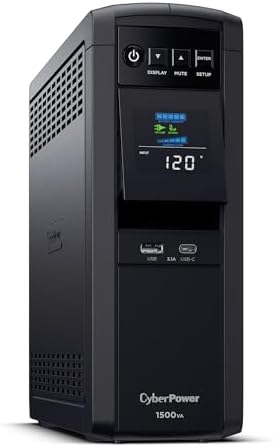
The CyberPower CP1500PFCLCD is a line-interactive UPS in a mini-tower form factor, built for people who need more than just a basic surge strip. It’s rated for 1500VA/1000W, which is enough to handle a solid desktop workstation, multiple monitors, networking gear, and a few accessories without gasping for air every time the lights flicker.
Physically, it feels reassuringly substantial without being a giant floor hog. It’s roughly the size of a small desktop tower, with a matte black finish that tucks nicely beside or under a desk. What I like most from a usability standpoint is the front color LCD panel. Instead of cryptic beeps and blinking lights, you get clear, at-a-glance information about load, estimated runtime, and any issues that might be brewing with your power.
The design is clearly aimed at home offices, creators, and small setups that need clean power but don’t want to jump into the world of heavy rack-mounted gear. You can plug in up to 12 devices, including sensitive electronics and networking equipment, and have confidence that a sudden outage or voltage dip won’t wreck your work or your hardware.
It’s also UL certified, which adds some peace of mind that the unit has been tested to recognized safety standards. When you’re trusting one box to sit between your wall outlet and thousands of dollars of computers and gear, that kind of certification matters more than most people realize.
Pros & Cons
Key Advantages
The biggest win here is that this UPS provides true sine wave output. That means it plays nicely with modern power supplies using active PFC, which you’ll find in most quality desktops, gaming rigs, and professional workstations. Cheaper units that only provide simulated sine wave can cause issues like power-supply buzzing, shutdowns, or just questionable reliability during an outage. With this model, systems tend to stay stable and behave normally when it kicks over to battery.
Another upside is the generous bank of 12 NEMA 5-15R outlets. Six of those are both battery backup and surge protected, and six are surge-only. In practice, this lets you prioritize what truly needs to stay on battery – things like your tower, monitor, router, modem, and NAS – while plugging less-critical gear into the surge-only section. It sounds small, but this separation keeps you from overloading the unit during a longer power cut.
The LCD screen is more than a gimmick. It shows real-time load percentage, input voltage, battery level, and estimated runtime. If you’ve ever wondered, “Can I safely add one more device?” this screen basically answers that on the spot. The tilting feature is surprisingly handy if the unit lives on the floor or under a desk, letting you read it without lying on the carpet.
Lastly, it includes two front USB charging ports – one Type-A and one Type-C. During an outage, it’s genuinely useful to keep your phone or tablet topped up without hunting for an extra charger. It’s not a replacement for a dedicated usb c portable battery charger, but as a convenient bonus it’s something I’ve used more than I expected.
Potential Drawbacks
No product is perfect, and this one has a few trade-offs worth mentioning. First, while this is a solid unit for a desk or media center, it’s not designed to be a whole-house ups battery backup. If you’re hoping to run large appliances or multiple high-draw devices for extended periods, you’ll hit its limits quickly. It’s meant for graceful shutdowns and short to moderate outages, not off-grid living.
Second, like most UPS systems with this capacity, it’s not feather-light. You’ll want to set it where it can live for a long time, rather than constantly moving it around. The weight comes from the internal battery, which is the trade-off that gives you more runtime and power handling.
Fan noise is generally modest, but when the unit is under high load or in battery mode, you will hear it. In a quiet room, it’s noticeable but not overwhelming. If you’re ultra-sensitive to any fan noise, putting it slightly away from your immediate listening area can help.
Finally, you do need to install and configure the free PowerPanel Management Software if you want deeper control and automatic OS shutdown for connected computers. It’s not complicated, but it’s one extra step that some people delay and then forget about until the first big outage hits.
- 1500VA/1000W PFC Sine Wave Battery Backup Uninterruptible Power Supply (UPS) System designed to support active PFC and c…
- 12 NEMA 5-15R OUTLETS: Six battery backup & surge protected outlets, six surge protected outlets; INPUT: NEMA 5-15P righ…
- MULTIFUNCTION, COLOR LCD PANEL: Displays immediate, detailed information on battery and power conditions; Color display …
Description and Real-World Experience
Power Protection You Actually Notice When Things Go Wrong
Day to day, a good battery backup should be boring. The CyberPower CP1500PFCLCD quietly conditions your power using Automatic Voltage Regulation, stepping in when the line voltage sags or spikes. In areas with flaky utility power, that AVR feature is what keeps your gear from seeing every minor brownout. Instead of instantly jumping to battery for every dip, it stabilizes things and saves those battery cycles for genuine outages.
In practical use, this means fewer unexpected reboots and fewer odd behavior moments from your computer or TV when the neighborhood power hiccups. I’ve seen it handle small voltage drops without me even noticing until I check the event history later. Over time, that kind of clean, consistent power can extend the life of your equipment in a way that’s hard to measure but very real.
When the power does go out, the switch to battery is almost seamless. Desktop systems keep running, monitors stay lit, and your networking gear doesn’t drop, which is critical if you’re in the middle of a video call or a cloud-based work session. That window of stable runtime is what lets you save files, safely shut down servers, or ride out a short outage entirely without interruption.
Runtime will vary based on your load, of course, but the LCD estimate is surprisingly accurate once the unit has learned your typical draw. If your goal is to handle brief interruptions and give yourself 10–20 minutes to shut down during longer cuts, this unit is perfectly aligned with that use case.
Everyday Convenience Features
The CP1500PFCLCD isn’t just a power brick; it’s actually thought through for everyday convenience. The right-angle plug with a 45-degree offset is one of those boring details that ends up being incredibly useful behind desks or entertainment centers. It lets you fit the UPS into crowded wall outlets or surge strips without blocking other plugs.
On the front, the USB Type-A and USB-C ports mean you can charge phones, tablets, or small accessories directly. During a power failure, using the UPS as a temporary usb c portable battery charger for your devices is a nice backup plan, especially if you forget to keep your usual power banks topped off.
The color LCD does more than just show numbers. It uses color-coding to warn you when something needs attention, like overload risk or a dropped input voltage. This visual cue is helpful if you’re not the type to routinely dig into logs or software dashboards.
And while it’s not talked about as much, the included three-year warranty that covers the battery, plus the $500,000 Connected Equipment Guarantee, adds a layer of peace of mind. It signals the company is confident enough in the product to stand behind it if there’s a failure that damages connected gear.
Comparing to Portable and Station-Based Options
It’s important to understand where this device sits compared to other power solutions. If you’re shopping for the best portable power station to take camping, work in a van, or carry around the house, this isn’t that. It’s a stationary UPS designed to live in one spot, plugged into the wall full-time. Its job is to bridge gaps in power and protect sensitive equipment, not to be a grab-and-go energy source.
Similarly, it isn’t meant as a general-purpose usb c portable battery charger for travel. The USB ports are great for convenience, but the unit is overkill for simply charging phones and tablets on the move. Think of it as a permanent power guardian for your high-value electronics, not a suitcase-friendly gadget.
Against smaller UPS units, the CP1500PFCLCD gives you a more comfortable overhead. Instead of running a UPS constantly at its limit, you can keep load levels lower, which is generally better for both longevity and noise. That overhead also means you can expand your setup slightly without immediately needing another backup device.
If your needs grow beyond a single office or entertainment zone, you’d start to look at multiple units or a more industrial ups battery backup solution. But for a typical workstation, creative studio corner, or home lab, this model hits a practical sweet spot between capacity, footprint, and cost.
- 1500VA/1000W PFC Sine Wave Battery Backup Uninterruptible Power Supply (UPS) System designed to support active PFC and c…
- 12 NEMA 5-15R OUTLETS: Six battery backup & surge protected outlets, six surge protected outlets; INPUT: NEMA 5-15P righ…
- MULTIFUNCTION, COLOR LCD PANEL: Displays immediate, detailed information on battery and power conditions; Color display …
Specs and Technical Details
Power and Output
The CyberPower CP1500PFCLCD is rated for 1500VA and 1000W, which is a useful combination to understand. The 1000W limit is what really governs how much gear you can run at once; most modern desktop systems with a couple of monitors, a router, and a NAS will come in well under that, but it’s always smart to add up approximate loads.
Output is a PFC sine wave, which is a major advantage for modern active PFC power supplies. This ensures compatibility and avoids strange behaviors that you sometimes see with cheaper, simulated sine wave units. For high-end gaming rigs or professional workstations with beefy PSUs, this compatibility can be the difference between a clean switchover and a hard shutdown.
The unit’s line-interactive topology, combined with Automatic Voltage Regulation, means it doesn’t sit idle until everything fails. It actively conditions your power, bringing low or high voltage closer to the ideal range and reducing the number of times it has to fall back on the internal battery.
Internally, the batteries are sealed lead-acid types, common in UPS designs. They’re user-replaceable when the time comes, though you should expect multiple years of service before needing to think about replacement under normal home or office conditions.
Connectivity and Control
On the back panel, you get 12 NEMA 5-15R outlets, split evenly between battery plus surge and surge-only. There’s also a USB connection for tying the UPS into a computer running the PowerPanel Management Software. With that software enabled, your system can monitor the UPS status and even trigger automatic, orderly shutdowns if battery levels drop too low during a longer outage.
This kind of integration is especially valuable for always-on devices like servers or network storage that you may not be sitting in front of when the lights go out. It cuts down on the risk of data corruption and avoids hard power cuts that shorten drive life.
The tilting LCD on the front provides a local control center, letting you cycle through readings, mute alarms, and check events without touching the software. The ability to angle that display up to 22 degrees is small but thoughtful, making it readable even when tucked under a desk.
Between the front panel and the software, you get enough control to fine-tune how the UPS behaves without being overwhelmed by complexity. It strikes a good balance between plug-and-play and power-user control.
Warranty and Protection
The three-year warranty is notable because it explicitly includes the battery, which isn’t always the case in this product category. Batteries are consumables, so having them covered for that full period gives you some cost certainty upfront.
The Connected Equipment Guarantee up to $500,000 is another layer of reassurance. While you’ll hopefully never need it, it indicates the manufacturer is confident in the device’s ability to protect connected gear from power issues it’s designed to handle.
Being UL certified means the unit has been tested against widely recognized safety standards, which matters when a device is always plugged in and working behind the scenes. For people concerned about long-term safety in home or office environments, this is not just a checkbox – it’s one of the reasons to choose a branded UPS over a no-name bargain option.
Taken together, these protections and certifications make the CP1500PFCLCD feel like a robust foundation for critical electronics, rather than just another box on the floor.
- 1500VA/1000W PFC Sine Wave Battery Backup Uninterruptible Power Supply (UPS) System designed to support active PFC and c…
- 12 NEMA 5-15R OUTLETS: Six battery backup & surge protected outlets, six surge protected outlets; INPUT: NEMA 5-15P righ…
- MULTIFUNCTION, COLOR LCD PANEL: Displays immediate, detailed information on battery and power conditions; Color display …
Why We Recommend This UPS
Balanced Power, Real-World Reliability
The main reason this model stands out is that it hits a practical sweet spot. It delivers enough capacity for serious home and small-office setups, provides true sine wave output for modern power supplies, and does it all without demanding data-center-level budgets or space. In actual use, it feels like a safety net that just quietly works.
From an everyday perspective, having a reliable battery backup means fewer stressful moments. When you hear thunder roll in or see your lights briefly dim, knowing your workstation, router, and storage are buffered by a solid UPS does wonders for peace of mind. You’re less likely to lose unsaved work, corrupt files, or experience those mysterious “my computer just died once” incidents that often trace back to power issues.
For people who work from home, freelance, or run small businesses, a unit like this isn’t just about convenience. It directly supports uptime and professionalism. Being able to stay online through short outages or at least wrap up a call and send a quick message during a longer one can make the difference between a minor hiccup and a major headache.
Professionally, I’ve seen this class of UPS pay for itself quickly by preventing a single serious incident of data loss or equipment failure. Replacement hardware and lost work hours add up fast; compared to that, investing in a strong line of defense at the outlet is a pretty straightforward decision.
Value Compared to Alternatives
Against smaller UPS units, the CP1500PFCLCD offers a much more comfortable margin. Running close to the limit of a small backup box is a recipe for overload beeps and short runtimes. With 1000W capacity, you can design a setup that uses only a portion of that, giving the system more breathing room and extending the practical life of the battery.
Against more expensive, enterprise-grade options, this unit brings many of the key benefits – sine wave output, AVR, decent runtime – in a more accessible form. You don’t need rack space, specialized wiring, or complex management tools to get meaningful power protection in a home environment.
It’s also more purpose-built and efficient than trying to rely on something like the best portable power station for dedicated computer protection. Portable power boxes shine when you want mobility and lots of AC outlets on the go, but they’re not optimized to sit, plugged in 24/7, conditioning your power and managing graceful shutdowns.
In that sense, the CP1500PFCLCD offers focused value: it specializes in one job – guarding your electronics from the wall outlet – and does it very well for the price point.
How to Get It and Related Accessories
If you’re ready to add a serious layer of protection to your setup, you can check current pricing and availability for the CyberPower CP1500PFCLCD here: CyberPower CP1500PFCLCD on Amazon.
For users with larger setups or multiple workstations, pairing this UPS with a second unit for your network rack or entertainment center can offer more tailored coverage. You can explore compatible CyberPower models with different capacities here: additional CyberPower UPS options. If you also want something more mobile for travel or outdoor use, consider adding a separate portable solution: portable power stations are better suited for that role.
To round out your protection, don’t forget solid surge strips for non-critical devices. While this UPS covers your essential gear, you can keep everything else safer with dedicated surge protectors: quality surge protector power strips. Paired with proper cable management and a bit of planning, you end up with a cleaner, safer, more resilient setup overall.
- 1500VA/1000W PFC Sine Wave Battery Backup Uninterruptible Power Supply (UPS) System designed to support active PFC and c…
- 12 NEMA 5-15R OUTLETS: Six battery backup & surge protected outlets, six surge protected outlets; INPUT: NEMA 5-15P righ…
- MULTIFUNCTION, COLOR LCD PANEL: Displays immediate, detailed information on battery and power conditions; Color display …
Who This Is NOT For
Despite its strengths, the CP1500PFCLCD isn’t the right choice for everyone. If your goal is whole-home resilience, including large appliances, HVAC systems, or long off-grid operation, you’ll outgrow this kind of unit quickly. In that case, you should be looking at dedicated home backup systems or generator and storage solutions designed for sustained, high-load operation.
It’s also not ideal if you move your power gear around frequently. A true best portable power station is lighter, designed with carrying handles, and meant to be charged and discharged in a more flexible way. This UPS wants to live in one spot and perform its job quietly from there.
Gamers or creators running extremely power-hungry rigs with multiple GPUs and huge monitor arrays should double-check their total draw. While 1000W is generous, it’s not unlimited, and you don’t want to run any UPS habitually right at its ceiling. In some edge cases, a higher-capacity model or multiple UPS units might be smarter.
Finally, if your power is already very stable and you’re only using a single low-power laptop, you might be better served by a simpler surge protector and a compact external battery for mobile charging. The CP1500PFCLCD shines most when you have real equipment to protect and a genuine risk of outages or voltage instability.
Complementing Ideas and Helpful Resources
Once you’ve got a solid UPS in place, the next step is thinking holistically about your power and data safety. One smart addition is a robust backup strategy for your files. Pairing this UPS with a local NAS and an offsite or cloud backup gives you multiple layers of protection – power issues won’t take your system down abruptly, and if something does happen, your data still lives elsewhere.
If you want to dig deeper into how UPS units work, including terms like line-interactive topology and AVR, resources from reputable sites such as How-To Geek do a good job breaking down the basics in user-friendly language. Understanding those fundamentals helps you size your UPS correctly and avoid both underbuying and overkill.
For broader context on home-office safety, the U.S. Department of Energy’s consumer resources at energy.gov can be a helpful reference, especially if you’re thinking about combining a UPS with surge protection, efficient equipment, or even small-scale solar down the road.
Within your own setup, consider mapping out what absolutely must stay on during an outage versus what can safely power down. This simple exercise helps you allocate the UPS outlets intelligently and keep total load at a comfortable margin. Combined with some basic cable organization and labeling, you’ll end up with a cleaner, more reliable, and more maintainable system.
Finally, if you already run a home media or office setup, reviewing how this UPS will integrate with your existing gear is helpful. For more ideas on protecting electronics and optimizing home equipment, you can explore related guides and setup inspiration on our site: see our overview of home office power protection and our breakdown of surge protectors vs. UPS units for deeper context.
- 1500VA/1000W PFC Sine Wave Battery Backup Uninterruptible Power Supply (UPS) System designed to support active PFC and c…
- 12 NEMA 5-15R OUTLETS: Six battery backup & surge protected outlets, six surge protected outlets; INPUT: NEMA 5-15P righ…
- MULTIFUNCTION, COLOR LCD PANEL: Displays immediate, detailed information on battery and power conditions; Color display …
Your Questions, Answered
How long will the CyberPower CP1500PFCLCD keep my PC running during an outage?
Runtime depends heavily on your total load, but for a typical desktop, monitor, and networking gear drawing around 300–400 watts, you can generally expect roughly 10–20 minutes of runtime from the CyberPower CP1500PFCLCD. The built-in LCD gives a live estimate once it sees your actual draw, which is much more accurate than generic charts. Keep in mind this unit is designed to give you enough time to save work, finish critical tasks, and shut down gracefully, rather than acting like an all-day battery backup for continuous off-grid use.
Can this UPS handle a gaming PC with a high-wattage GPU?
Yes, as long as your gaming rig plus everything else plugged into the battery-backed outlets stays within the 1000W limit of the CyberPower CP1500PFCLCD. Most systems idle well below their PSU rating, so you’re often safer than the power-supply label might suggest. Still, it’s smart to estimate your load using online PSU calculators or by checking the UPS’s LCD after connecting. If you see the load consistently above 70–80%, consider offloading some devices or moving up to a higher-capacity model.
Is this UPS compatible with active PFC power supplies?
Yes. The CP1500PFCLCD outputs a pure sine wave when running on battery, which is exactly what active PFC power supplies are designed for. This is one of the main reasons to choose this model over cheaper, simulated-sine-wave units. Active PFC PSUs in modern desktops, workstations, and many gaming systems tend to behave far more reliably and quietly when paired with a sine-wave UPS, especially during transitions between line and battery power.
Can I use this instead of a portable power station for travel or camping?
Not realistically. While the UPS technically stores energy in its internal battery, it’s engineered to live plugged into a wall outlet and provide short-term emergency power and conditioning for electronics, not to serve as a portable power station. If you need something you can carry around, charge from various sources, and use away from the wall, a dedicated portable power station is a better match. The CyberPower CP1500PFCLCD should be treated as fixed infrastructure for your desk or media setup.
Do I need any special software to use the automatic shutdown features?
To enable automatic operating system shutdown on a connected computer, you’ll want to install CyberPower’s free PowerPanel Management Software and connect the UPS via USB. Out of the box, the unit works as a surge protector and battery backup without software, but PowerPanel lets your system monitor battery levels, log events, and shut down safely during extended outages. Setting it up typically takes just a few minutes and is highly recommended if you’re protecting important work or always-on systems.

We are a collective of off-grid enthusiasts, solar technicians, and sustainable living advocates dedicated to making energy independence accessible. From blackout-proofing suburban homes to engineering mobile power for the road, we rigorously test every kit and component we review. Our mission is to help you cut the cord and power your life on your own terms.