
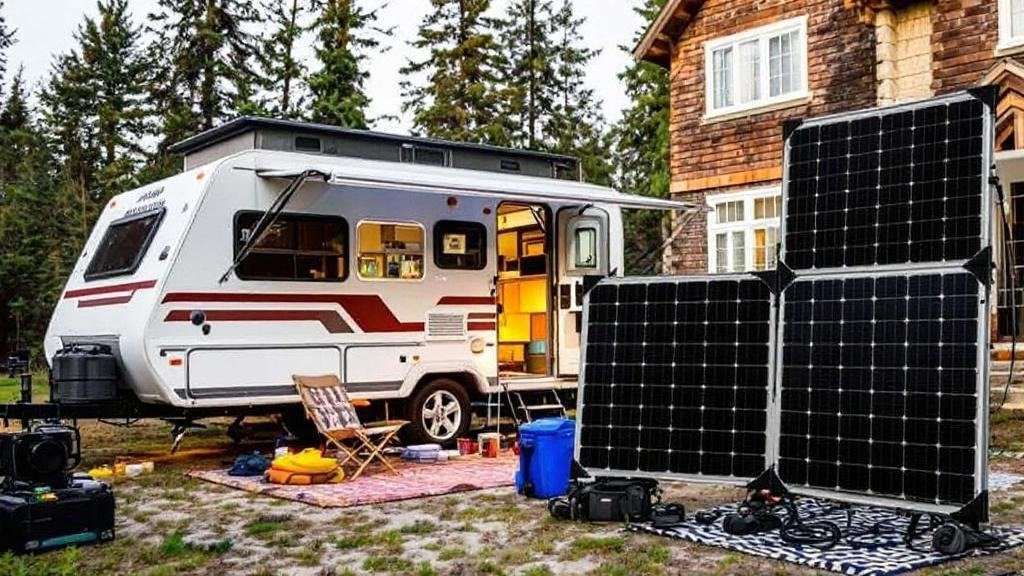


If you’ve been hunting for a simple way to keep your batteries topped up while camping, boondocking, or running a small off-grid setup, this Renogy 100W suitcase is one of those rare products that feels genuinely practical. It doesn’t try to be a full-blown power system; instead, it focuses on doing one job really well: turning sunlight into reliable 12V charging without a bunch of installation headaches.
Over time, I’ve seen plenty of DIY setups go sideways because of cheap charge controllers, flimsy wiring, or panels that perform great on paper but not so great in real-world conditions. What makes this particular kit stand out is how quickly you can go from trunk to charging, plus the fact that it’s built around a proven brand that RVers and van lifers already trust. Let’s walk through what it actually offers and who it’s best suited for.

- 【25% High-Efficiency】Powered by N-Type cells boasting up to 25% conversion efficiency, this 100w solar panel delivers ex…
- 【Compact & Portable Foldable Design for On-the-Go Power】This renogy portable solar panel folds into a sleek, suitcase-si…
- 【Plug & Play Ready】Forget complicated wiring—this solar panel kit comes with a pre-installed waterproof 20A PWM charge c…
Renogy 100W Portable Solar Suitcase Product Showcase
At its core, this is a 100 watt folding suitcase panel paired with a 20A waterproof charge controller and alligator clips. You unfold it, point it at the sun, clip it to your 12V battery, and you’re generating power. No rooftop drilling, no permanent wiring through your RV walls, and no messing with separate components that may or may not play nicely together.
The panel uses Grade A+ monocrystalline cells, which is a fancy way of saying the cells are high-quality and designed for better efficiency than bargain-bin options. In practice, that means you get more usable charging power out of the same amount of sunlight, especially in partial or less-than-perfect conditions. The included stand lets you tilt the panel toward the sun instead of leaving it flat on the ground, which also helps squeeze out extra watts over the course of the day.
One thing I appreciate is that the charge controller is already mounted and wired on the panel frame. For someone who doesn’t want to think about volts, amps, and connection diagrams, that’s a big plus. You literally have a plug-and-play setup that behaves like a self-contained power station feeder for your existing batteries, whether that’s an RV house battery, a small cabin bank, or even a simple marine battery at a remote dock.
When folded, the whole kit tucks into a rugged canvas case with a heavy-duty handle and metal latches. It’s not featherlight, but it feels like something you can toss into the back of a truck with camping gear and not worry about babying. For people who set up camp and move frequently, that convenience matters way more than shaving off a couple of pounds on paper.
Pros & Cons
What This Kit Does Really Well
The biggest win here is ease of use. Everything is included and pre-wired, so there’s no need to source a separate controller or figure out which gauge wire to buy. For anyone new to solar, that alone can save hours of frustration. You unfold, aim, and clip onto a 12V battery, and the PWM controller handles charging automatically.
Portability is another strong point. Because it folds like a briefcase, it’s much more flexible than a rigid rooftop setup. You can park your RV in the shade and run the panel out into the sun with an extension cable, or move it as the sun shifts through the day. This is a big deal for boondockers who don’t always have a perfect south-facing site.
There’s also peace of mind in the built-in protections. The controller includes multiple safety features overcharge, short circuit, and reverse polarity protection so you’re not babysitting the system or worrying about accidentally cooking your battery. And with Renogy backing it with a 2-year material and workmanship warranty, it’s not one of those no-name products you hope will last through one season.
Where It Could Be Better
No product is perfect, and this one’s no exception. For starters, 100W is great as a starter or supplemental panel, but it’s not going to support large power hogs like air conditioners, residential fridges, or heavy-duty inverters on its own. Think battery maintenance, lights, fans, small electronics, and keeping a modest camping setup alive not whole-house off-grid living.
The PWM controller is reliable and simple, but it’s not as efficient as a quality MPPT controller, especially in cooler temperatures or when your battery voltage is on the lower side. If you’re trying to squeeze every possible watt-hour out of your setup, you might eventually want to upgrade controllers or choose a different configuration.
It’s also worth noting that a suitcase panel needs to be set up and taken down each time. For some people, that’s no big deal and even a benefit because it’s flexible. For others who prefer a “set it and forget it” roof install, the daily setup could feel like an extra chore. Finally, while the case is rugged, it’s still a piece of glass and aluminum treat it like gear, not like a steel toolbox.
- 【25% High-Efficiency】Powered by N-Type cells boasting up to 25% conversion efficiency, this 100w solar panel delivers ex…
- 【Compact & Portable Foldable Design for On-the-Go Power】This renogy portable solar panel folds into a sleek, suitcase-si…
- 【Plug & Play Ready】Forget complicated wiring—this solar panel kit comes with a pre-installed waterproof 20A PWM charge c…
Description & Real-World Details
Plug-and-Play 100W Folding Design
This 100w solar panel suitcase is essentially two 50W monocrystalline panels hinged together. When folded, it feels about the size of a slim briefcase and slips into the included protective canvas bag. The zipper, stitching, and padding are noticeably more substantial than the budget options floating around online, which matters when you’re tossing it in and out of a truck bed.
Once you unzip and unfold it, the panels lock open, and you can flip out the adjustable kickstands. These stands let you choose a tilt angle so the modules face the sun more directly. That means better energy harvest compared to a flat, fixed panel, particularly in the early morning and late afternoon when the sun is lower.
The factory wiring is already run through to the 20A waterproof charge controller, which is attached directly to the panel frame. From there, you get a pair of alligator clips for fast connection to your battery posts. There’s no guesswork about which cable goes where everything is labeled, and if you’ve ever jumped a car battery, you can handle this setup.
Controller, Safety, and Battery Compatibility
The included PWM charge controller is really the brains of the operation. Its job is to take the raw solar input and feed your 12V battery at safely controlled voltage and current. It also adds several layers of protection: overcharge protection to prevent cooking your battery, short-circuit and reverse polarity safeguards, and basic temperature tolerance.
Renogy designed this kit to play nicely with several types of 12V batteries. That includes standard flooded lead-acid, AGM, gel, and many 12V lithium (LiFePO4) options. Always double-check your specific battery’s requirements, but for the most part, this is a versatile match for the typical RV, boat, or off-grid system.
Because the controller is 20A, you’ve got headroom if you decide to add another matching panel in the future (within the controller’s limits). That gives you a small upgrade path without having to replace the entire kit right away. It’s a thoughtful balance between simplicity and expandability.
Build Quality, Durability, and Weather Readiness
In terms of construction, the aluminum frame feels solid without going overboard on weight. The corners are reinforced, and the latches snap shut firmly, which gives you confidence when you’re carrying it by the handle. The canvas case adds another layer of abrasion and impact protection, useful when it’s sliding around with coolers and camp chairs.
Renogy rates the charge controller as waterproof, a big reassurance if you get caught in a surprise shower or morning dew. That said, like any electronics, it’s still smart to avoid leaving the panel sitting in standing water or in extreme conditions if you can help it.
Efficiency-wise, the Grade A+ monocrystalline cells are designed to deliver strong performance for the footprint. While no panel is immune to losses from shade, heat, or dirt, these higher-grade cells typically hold up better than entry-level options, especially over longer use. For people who camp in shoulder seasons or at higher latitudes, that bump in efficiency can be the difference between a topped-off battery and one that slowly drains.
Specs & Technical Breakdown
Panel and Electrical Specs
This kit is built around a 100W 12v solar panel setup, configured as a folding suitcase. The nominal voltage matches typical 12V systems, making it a natural fit for RV house batteries, small boat banks, and off-grid cabins using 12V inverters or DC loads. Because of the 100W rating, you’re generally looking at a realistic daily harvest of around 300–500Wh in decent sun, depending on angle and location.
The output connects through the integrated 20A PWM controller, which regulates voltage to safe levels for charging. While Renogy doesn’t brag about every detailed spec in the marketing copy, users commonly see solid, stable current flow to their batteries on clear days. It’s not meant for high-voltage arrays or big multi-string systems this is a compact, single-panel solution.
From a wiring standpoint, the kit comes pre-terminated with alligator clips for immediate use. If you’re more advanced or picky about your wiring, you can adapt this with MC4 connectors or extension cables to reach further distances, but out of the box it is clearly targeted at people who want simple, direct connections.
Charge Controller Performance and Capacity
The 20A rating on the included controller provides a nice safety margin for a 100W panel, since 100W at 12V equates to roughly 8A under ideal conditions. This means the controller is loafing rather than being pushed to its absolute limit, which is usually good for longevity. It’s also what makes adding a second 100W panel a realistic future upgrade for some setups.
PWM technology is less complex than MPPT, and while you give up some absolute efficiency in marginal conditions, you gain a simpler design that’s easy to understand and generally very reliable. The controller monitors battery voltage and adjusts its output accordingly, helping extend battery life by avoiding chronic overcharging.
The waterproofing is another underappreciated aspect. If you’ve ever dealt with a budget controller that failed after a damp weekend, you’ll know why this matters. Renogy’s focus on outdoor ratings makes this better suited to real-world camping and RV scenarios instead of just living on a spec sheet.
- 【25% High-Efficiency】Powered by N-Type cells boasting up to 25% conversion efficiency, this 100w solar panel delivers ex…
- 【Compact & Portable Foldable Design for On-the-Go Power】This renogy portable solar panel folds into a sleek, suitcase-si…
- 【Plug & Play Ready】Forget complicated wiring—this solar panel kit comes with a pre-installed waterproof 20A PWM charge c…
Portability, Dimensions, and Handling
Although exact dimensions vary slightly by production run, this style of 100W suitcase is typically compact enough to slide behind a truck seat or into a small RV storage bay. The heavy-duty handle is balanced near the center of gravity, so even when the panel is in its case, it doesn’t feel awkward to carry.
In practice, you can carry it in one hand, a duffel of gear in the other, and still have a free arm to open a door. That may sound like a small design detail, but for people constantly setting up and breaking down camp, those small conveniences add up over time.
Because it’s a standalone unit, there’s no need to reserve rooftop real estate or modify your rig. If you change vehicles or upgrade your camper later, you simply take the suitcase with you. That portability is a big part of this kit’s long-term value.
Why We Recommend This Kit
The main reason this kit stands out is the balance between simplicity and capability. It’s powerful enough to make a real, noticeable difference to your battery life, but simple enough that you don’t need an electrician’s background to use it safely. For most weekend campers, casual boondockers, and folks dipping their toes into solar for the first time, that’s exactly what they need.
I also like that it fits naturally into a modular power system. Already have an RV with a factory-installed converter and battery? This drops in as a supplemental charger. Have a portable power station that accepts 12V input with the right adapter? This can act as your panel source. Running a small hunting cabin with a single deep-cycle battery? Same story no redesign required.
Is it the absolute cheapest way to get 100W of solar? Probably not. But you’re paying for build quality, a well-matched controller, and support from a brand with a track record. Over a few seasons of real use, that tends to be a smarter investment than constantly replacing bargain gear that fails at the worst times.
For people comparing options, this sits in a sweet spot: more robust than ultra-light fabric-style panels, less commitment than a full roof array, and much friendlier than a DIY wiring project. That’s why it’s often recommended as the “first serious solar kit” for campers and RVers who are ready to move beyond basic battery chargers and noisy generators.
If you want to check current pricing or reviews, you can see it on Amazon and see how other campers are putting it to use.
Who This Is NOT For
This kit is not a magic bullet for heavy power users. If you’re trying to run a residential fridge, a large inverter, or air conditioning for long stretches off-grid, 100W of solar just isn’t the right starting point. In that case, you should be looking at multi-panel arrays, higher-capacity batteries, and likely a more advanced system design.
It’s also not ideal for people who absolutely hate the idea of setting something up outside each day. If you want a “flip a switch and forget it” solution that lives permanently on your roof, you’re probably better off with fixed panels and a separate charge controller mounted inside your rig.
Finally, if you’re on a razor-thin budget and every dollar matters more than warranty or build quality, the Renogy suitcase might feel a little premium compared to ultra-cheap imports. Those can work for light or experimental use, but they rarely offer the same safety features, documentation, or support.
In short, this is for people who value reliability, portability, and ease of use over chasing the absolute lowest cost or trying to power an entire off-grid house from a single panel.
Complementing Ideas & Helpful Resources
To get the most from a portable solar setup like this, it helps to think about your broader power system. Pairing the suitcase with a quality deep-cycle battery and a modest inverter can turn even a simple camper into a surprisingly capable off-grid base. If you’re just starting to plan a system, our guide to going solar at home is a useful big-picture overview of how panels, batteries, and controllers interact.
For RV owners who want to dive deeper into system design whether you stick with portable solar panels for camping or eventually graduate to a full roof array it’s worth reading through the RV electrical safety basics at a national RV association site. Understanding wire sizing, fusing, and battery maintenance will help you get more life from your gear and avoid expensive mistakes.
If you’re comparing this Renogy suitcase to other options or planning add-ons like inverters, batteries, or roof panels, we’ve also put together some internal walkthroughs of beginner-friendly setups: check out our overview of portable power gear in our RV solar beginner’s guide and our breakdown of portable vs rooftop RV solar systems for real-world pros and cons.
Used thoughtfully, a compact setup like this can dramatically cut your generator runtime, keep your essentials powered, and make life at camp noticeably quieter and more relaxed. It’s not about chasing huge numbers; it’s about having dependable, easy power wherever you decide to park.
- 【25% High-Efficiency】Powered by N-Type cells boasting up to 25% conversion efficiency, this 100w solar panel delivers ex…
- 【Compact & Portable Foldable Design for On-the-Go Power】This renogy portable solar panel folds into a sleek, suitcase-si…
- 【Plug & Play Ready】Forget complicated wiring—this solar panel kit comes with a pre-installed waterproof 20A PWM charge c…
Your Questions, Answered
Can this portable solar suitcase run my RV air conditioner?
No. A 100W portable suitcase like this is great for charging your 12V battery, running lights, fans, and small electronics, but it’s nowhere near powerful enough to run an RV air conditioner directly. Air conditioners typically require a large inverter, a big battery bank, and several hundred watts (often 600W–1,000W or more) of panels. Think of this kit as a smart way to maintain and top off your batteries, not as a full replacement for shore power when it comes to major appliances.
Is this kit compatible with lithium (LiFePO4) batteries?
Yes, in most cases. The included 20A PWM charge controller is designed to work with multiple 12V battery types, including many LiFePO4 batteries, but you should always check your specific battery’s charging requirements. Make sure the controller’s voltage settings match the recommended profile from your battery manufacturer. If you plan a larger lithium bank or very heavy use, you might eventually choose to pair the panel with a more advanced MPPT controller tuned specifically for lithium chemistry.
How much power can I realistically expect from this 100W setup each day?
Real-world output depends on sun angle, weather, temperature, and shading, but a 100W panel typically delivers around 300–500 watt-hours per day in decent conditions. That’s enough to recharge phones, tablets, cameras, small fans, LED lights, and to offset some of the draw from a modest RV or camper battery. In peak summer sun with careful panel positioning, you might see more, while cloudy or shaded conditions will significantly reduce output.
Do I need any extra parts to start using this camper solar panel kit?
For basic use, you don’t. The suitcase comes with the 100W panel, a 20A waterproof charge controller, and alligator clips to connect directly to your 12V battery. That’s enough to start charging as soon as you unfold the panel. Over time, many people add extension cables to place the panel farther from their RV, fuses or breakers for extra safety, and upgraded connectors if they integrate the kit into a more permanent system, but none of those are strictly required to get started.
Is this a better choice than roof-mounted panels for camping and RV use?
It depends on your style of travel. Portable solar panels for RV camping are ideal if you like parking in the shade, moving camp often, or using the same kit with multiple vehicles or at a cabin. You can chase the sun by repositioning the panel throughout the day. Roof-mounted arrays are better if you want a permanent, hands-off solution and don’t mind parking in the sun. Many RVers eventually use both: a fixed roof system for baseline charging and a portable suitcase like this for extra flexibility and power when boondocking.

We are a collective of off-grid enthusiasts, solar technicians, and sustainable living advocates dedicated to making energy independence accessible. From blackout-proofing suburban homes to engineering mobile power for the road, we rigorously test every kit and component we review. Our mission is to help you cut the cord and power your life on your own terms.